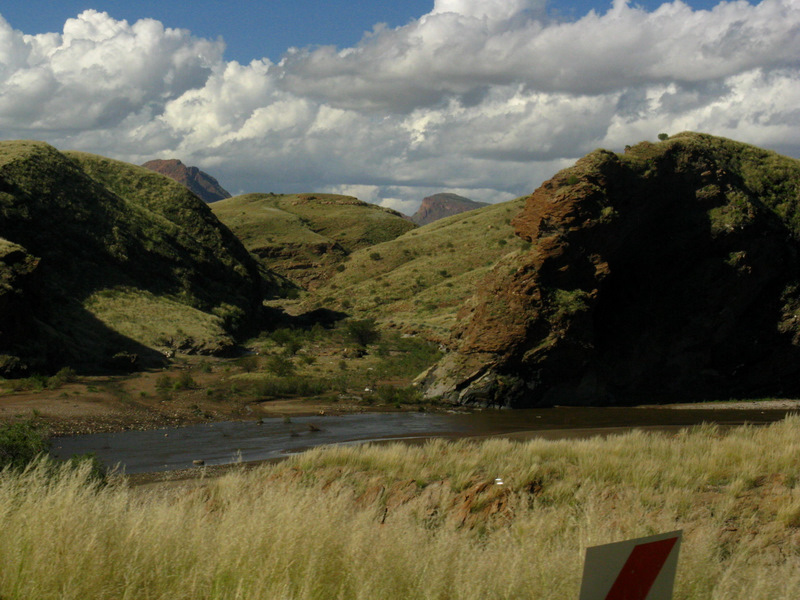
With a 630 km drive ahead of us, we got the tents and truck packed up and left
Onguma Bush Camp early.
The drive from Onguma Bush Camp to
Divundu in Namibia's
Caprivi Strip is on tar roads. In Namibia, tar roads are usually faster travel than over the same distance on gravel. That was certainly the case from Onguma to the veterinary line. The veterinary line cut across our path right about at Mururani on the way to
Rundu.
South of the line, land is privately owned and fenced. North of the veterinary line, communities own the land communally and there are no fences.
The line is in place to prevent the movement of meat products (and cattle) from the north where there are pockets of hoof and mouth disease to the south where it ostensibly doesn’t exist. Farmers raising cattle commercially in the south have access to meat markets in Namibia and Europe. Cattle raised in the north and meat products from this area are not allowed to be exported south of the line to avoid the potential transmission of disease and do not have access to the same meat markets as those available to the south.
People have told us that once you cross the veterinary line into the Caprivi Region, you are in true Africa. There is definitely a big difference from the territory south. Without fences, cattle, goats and sheep roam freely, crossing the roads wherever they want.
Housing is primarily thatched huts or wood and daub construction with thatched or corrugated metal roofs. An extended family's huts, and indeed, entire villages are often enclosed by high reed fences. This may afford some protection from elephants as they are more likely to go around a large enclosed entity than they are an individual grass hut.
As you can imagine, with animals on the road, the going was a bit slower than we had experienced before the line. Without fences, game animals roam freely as well. We had hoped we would see elephants
but no luck on this leg of the trip. We stopped briefly in Rundu for more groceries then drove straight to Divundu and south to
Nunda Safari Lodge. We arrived in time to set up camp
and explore a bit before dinner. This is the ladies’ ablution block at Nunda (the men's was identical).
It was the most thoughtful one we had seen -- a garden in the middle and showers and sinks on one side, toilets on the other. They light the
donkey about 4PM each day which provides ample hot water for showers at night, clothes and dish washing, and actually, is still warm enough for a shower the next morning. When it gets going, the fire under the donkey's water tank works pretty darn well to provide absolutely scalding water (it goes without saying you have to be exceedingly careful adjusting the showers!).
Donkeys are an amazingly effective hot water generation system in the middle of the bush and are frequent in remote campgrounds throughout Namibia. I became enamored with the term, “light the donkey," and wished there were simply more opportunities to use that unusual phrase in conversation. You’d be surprised though at how hard it is to fit that into conversation anywhere!
Nunda Safari Lodge is on the banks of the
Kavango River. The dining room faces out onto the deck overhanging the river.
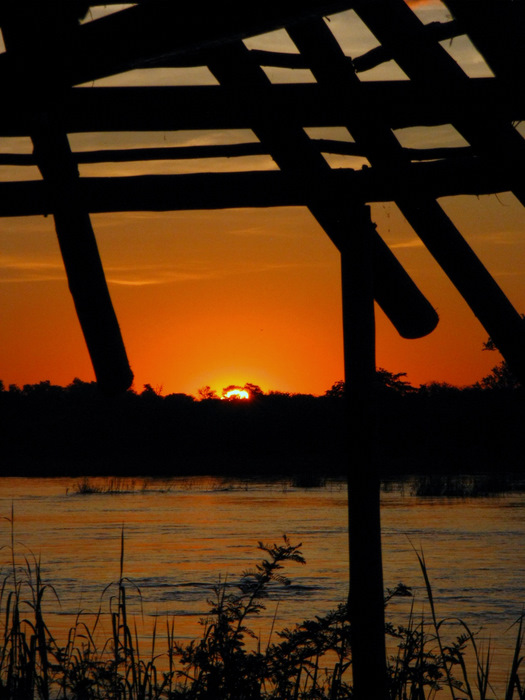
Our first night there, we were too late for the boat trip on the river so we took in the sunset from the deck, had a wonderful dinner, and made plans for a boat trip the following afternoon.
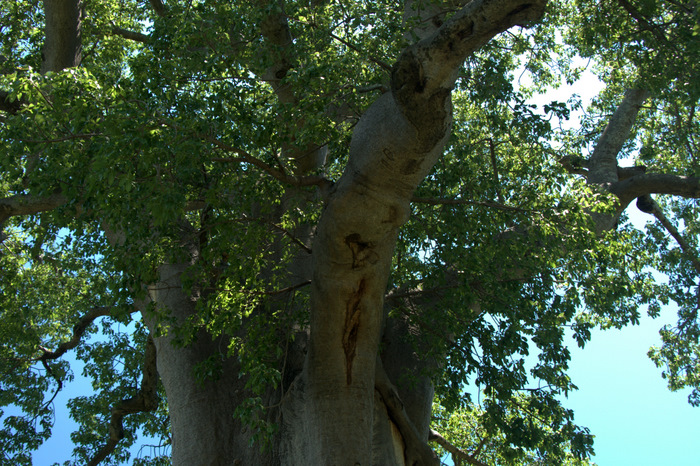
The next morning, we set out for Mahango Game Reserve hoping to see elephants. We had been told they were often seen in the Reserve. Mahango is a pretty riverine area with lots of tropical birds, some impala, and ostensibly elephants, lions, and cheetah among the exotic wild game known to be in the park. However, we saw only a few impala, some birds, massive baobab trees, knob thorns whose bark in silhouette looks like crocodile teeth, but mainly just lush green tropical landscape.
 |
| Impala |
 |
| Lush riverine woods |
 |
| Little Bee Eater |
 |
| Baobab canopy |
 |
| Baobab trunk |
 |
| Baobab blossom |
 |
| Knob Thorn |
We headed back to the campsite to tackle the pile of laundry that had been piling up, and to restore some order to the back of the truck
before boarding the the pontoon tour boat at 5pm.
The Kavango River continues from this location in Namibia south into the
Okavango Delta in Botswana. It was a smooth trip up to Popa Falls which are an area of fast rapids over an expanse of boulders.
 |
| Popa Falls |
Along the river banks people from nearby villages were fishing, bathing, doing laundry, and gathering water from the river. After the falls, we turned back and headed back down the river beyond the Lodge in the opposite direction where these guys hang out.
We weren’t as close as it looks from these photos which was just fine as these hippos were huge. One really doesn't want to be too close.
About 350 photos later, we headed back to the Lodge toward the sunset and our final dinner there.
While we enjoyed a riverside dinner, a spider (likely a bark spider) living back at the ablution blocks had spun this intricate web to catch its evening meal.
By morning there was not a trace of the web.
We were told by the biologist in the family that these particular spiders build their webs back every evening and take them down again every morning ...hard work anyway you look at it. I could identify. It's sort of like camping.....unloading and packing up the truck every day.