Showing posts with label hippopotamus. Show all posts

April 07, 2011

Camping Safari Days Fourteen and Fifteen – Divundu to Kongola


We didn’t have as far to drive this day so took our time leaving Nunda River Lodge, taking more photos to remember it by.

Morning dew on varied grasses at Nunda

Very tiny frog near swimming pool at Nunda
Gray Go Away Birds

Meve's starling

Meve's starling

Yellow-bellied greenbul

Nunda River Lodge deck over the Kavango River

Once underway from Divundu, we encountered a pretty long stretch of highway through the Bwabwata National Park with reduced speed limits to protect motorists and elephants alike.


I talked to several people who had seen large herds crossing in this area, but unfortunately, we didn’t see a one.

We arrived at Namushasha Country Lodge in late afternoon and set up camp before afternoon rains arrived.


Just off to the left in this photo, and beyond the shorter fence, the ground sloped down to the Kwando River where we could hear hippos in the water at night.

The sign on the ablution block reads: “CAUTION Hippo & Elephant Movement At Night”. Getting up in the middle of the night for the bathroom gave us definite pause for thought.

Donkey heating water and warning sign re: hippos and elephants
But despite a real likelihood, our no-luck scenario prevailed and we had yet to see a single elephant on this trip. if there were elephants and hippos roaming at night, they were amazingly quiet moving through the camp.

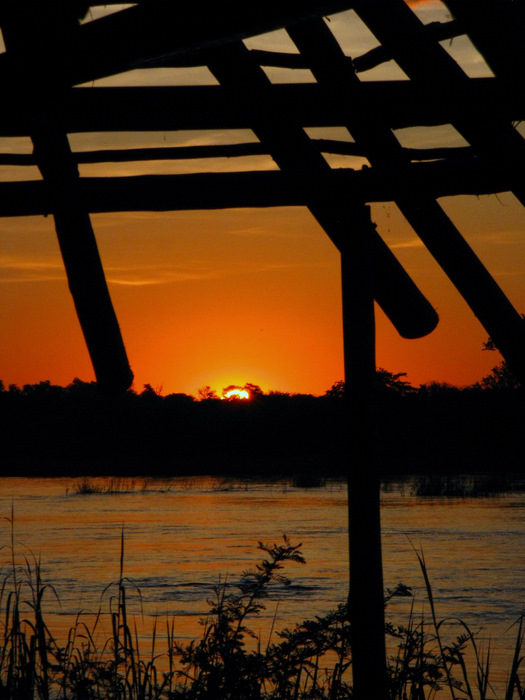
Just before we left for dinner at the Lodge, the sun was going down over the river. While I’m now used to seeing vivid pink in Namibian sunsets, this was the pinkest sunset I’ve seen since we’ve been here.

Sunset, January 11, 2011 at Namashasha Country Lodge

Kwando River

Kwando River at Sunset January 11, 2011


The next morning, we took off for Mudumu National Park, not far away from the Lodge.  This is another pretty riverine area, bordering the Kwando River. 


The park roads were packed gravel/sand and only navigable by 4x4 vehicles.  The grass in some areas was above the hood of the truck.


 It turned out to be a great day for seeing animals.
Male vervet monkey with serious injury to his left front leg
At about 9AM that morning, a young herd of very wet elephants who had been bathing in the river, suddenly came out of tall grass to the right of the truck running across the road into more tall grass on the other side.  We were so surprised by their sudden appearance and they were in view for such a short time, that this is the only photo we were able to capture.  This young bull stopped briefly in the middle of the road to stare us down for a quick second or two before turning and following the rest of the herd to the grass. 


Zebras
Young vervet monkeys at play
Impalas practicing their mirror image tricks again

Wart hog
Mother and baby baboon
another wart hog

Rain was imminent by early afternoon so with worries about having to re-cross the miniature lakes disguised as puddles again on our way out, we thought it best to head back to the Lodge rather than risk being flooded out where we were. By 3:30 PM when we arrived back at the Lodge, tropical rains had already moved in.


Since the soaked patio wasn't available,


we moved into the lounge area inside to wait out the rain.


When we asked if we could get coffees for everyone, we were delighted to find a full afternoon tea was already set up in the dining room. Tea, coffee, spiral cakes, rusks, muffins,


and sumptious architectural cake constructions were on offer.


What a delightful way to wait out a rain!

We happily waited out the rain for a good hour and a half or so before getting back to our campsite to re-set camp for the night.


The only negative about roof tents, is you must take them with you wherever you go, so you need to set them up again each night. On a positive note, however, they go up (and down) very easily.

With so many clouds still overhead, there was no real color in the night’s sunset. After enjoying a beautiful buffet dinner at the Lodge, we retired for the night with somewhat wistful mindsets. The next day would begin our trip back to Windhoek and most sadly for the professor and me, the fast-approaching time to have to say good-bye to the kids. Oh well, there was still potential excitement to be had — maybe hippos or elephants would make it into our camp overnight.

Unfortunately, they didn’t.

April 01, 2011

Camping Safari Days Twelve and Thirteen – to Divundu in the Caprivi Region

With a 630 km drive ahead of us, we got the tents and truck packed up and left Onguma Bush Camp early.

The drive from Onguma Bush Camp to Divundu in Namibia's Caprivi Strip is on tar roads. In Namibia, tar roads are usually faster travel than over the same distance on gravel. That was certainly the case from Onguma to the veterinary line. The veterinary line cut across our path right about at Mururani on the way to Rundu.


South of the line, land is privately owned and fenced. North of the veterinary line, communities own the land communally and there are no fences.


The line is in place to prevent the movement of meat products (and cattle) from the north where there are pockets of hoof and mouth disease to the south where it ostensibly doesn’t exist. Farmers raising cattle commercially in the south have access to meat markets in Namibia and Europe. Cattle raised in the north and meat products from this area are not allowed to be exported south of the line to avoid the potential transmission of disease and do not have access to the same meat markets as those available to the south.

People have told us that once you cross the veterinary line into the Caprivi Region, you are in true Africa. There is definitely a big difference from the territory south. Without fences, cattle, goats and sheep roam freely, crossing the roads wherever they want.


Housing is primarily thatched huts or wood and daub construction with thatched or corrugated metal roofs.  An extended family's huts, and indeed, entire villages are often enclosed by high reed fences.  This may afford some protection from elephants as they are more likely to go around a large enclosed entity than they are an individual grass hut.


As you can imagine, with animals on the road, the going was a bit slower than we had experienced before the line. Without fences, game animals roam freely as well. We had hoped we would see elephants

 
but no luck on this leg of the trip. We stopped briefly in Rundu for more groceries then drove straight to Divundu and south to Nunda Safari Lodge. We arrived in time to set up camp


and explore a bit before dinner. This is the ladies’ ablution block at Nunda (the men's was identical).


It was the most thoughtful one we had seen -- a garden in the middle and showers and sinks on one side, toilets on the other. They light the donkey about 4PM each day which provides ample hot water for showers at night, clothes and dish washing, and actually, is still warm enough for a shower the next morning. When it gets going, the fire under the donkey's water tank works pretty darn well to provide absolutely scalding water (it goes without saying you have to be exceedingly careful adjusting the showers!).


Donkeys are an amazingly effective hot water generation system in the middle of the bush and are frequent in remote campgrounds throughout Namibia.  I became enamored with the term, “light the donkey," and wished there were simply more opportunities to use that unusual phrase in conversation. You’d be surprised though at how hard it is to fit that into conversation anywhere!

Nunda Safari Lodge is on the banks of the Kavango River. The dining room faces out onto the deck overhanging the river.


 Our first night there, we were too late for the boat trip on the river so we took in the sunset from the deck, had a wonderful dinner, and made plans for a boat trip the following afternoon.


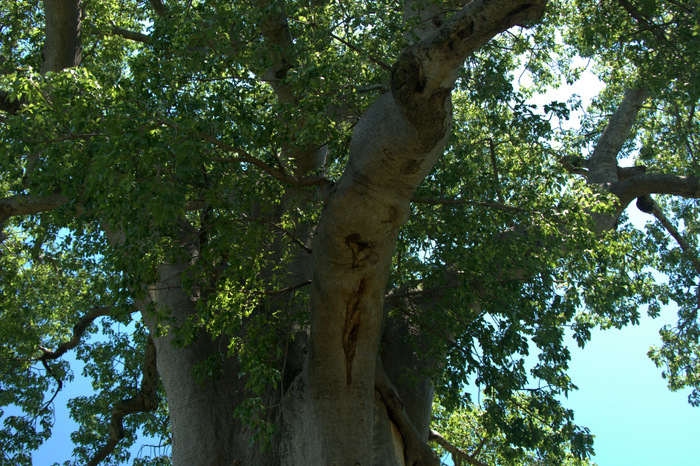
 The next morning, we set out for Mahango Game Reserve hoping to see elephants. We had been told they were often seen in the Reserve. Mahango is a pretty riverine area with lots of tropical birds, some impala, and ostensibly elephants, lions, and cheetah among the exotic wild game known to be in the park. However, we saw only a few impala, some birds, massive baobab trees, knob thorns whose bark in silhouette looks like crocodile teeth, but mainly just lush green tropical landscape.

Impala
Lush riverine woods
Little Bee Eater

Baobab canopy
Baobab trunk

Baobab blossom
Knob Thorn

We headed back to the campsite to tackle the pile of laundry that had been piling up, and to restore some order to the back of the truck


before boarding the the pontoon tour boat at 5pm.

The Kavango River continues from this location in Namibia south into the Okavango Delta in Botswana. It was a smooth trip up to Popa Falls which are an area of fast rapids over an expanse of boulders.


Popa Falls

Along the river banks people from nearby villages were fishing, bathing, doing laundry, and gathering water from the river. After the falls, we turned back and headed back down the river beyond the Lodge in the opposite direction where these guys hang out.


We weren’t as close as it looks from these photos which was just fine as these hippos were huge.  One really doesn't want to be too close.


About 350 photos later, we headed back to the Lodge toward the sunset and our final dinner there.


While we enjoyed a riverside dinner, a spider (likely a bark spider) living back at the ablution blocks had spun this intricate web to catch its evening meal.


By morning there was not a trace of the web.

We were told by the biologist in the family that these particular spiders build their webs back every evening and take them down again every morning ...hard work anyway you look at it.  I could identify. It's sort of like camping.....unloading and packing up the truck every day.