Showing posts with label Swakopmund. Show all posts

February 21, 2011

Camping Safari Day Six — Swakopmund, Walvis Bay, and Dune 7

Day six was an idle day of sightseeing and hanging out in Swakopmund and Walvis Bay. It was overcast, much like the majority of mornings in Swakopmund (Swakop to the locals). Cool, humid air moves in from the Atlantic over Swakopmund and Walvis Bay overnight but instead of forming clouds and pushing inland, the moist air meets dry warm air masses from the adjacent desert and cannot rise to form clouds. Instead, it forms fog over the coastal area that can extend inland up to 30 miles. The fog takes a good while to burn off each day and sometimes, doesn’t burn off at all. Those cool moist breezes coming off the ocean and dreary skies overhead made a perfect reason to warm up over a cappuccino at an open-air cafe with a view to the sea. While we waited for our son-in-law to finish some research at a nearby internet café, we passed the time watching the ocean and the seabirds nearby.


Cape cormorant
The day’s plan was to do some birding around the lagoons of Walvis Bay and then to the big dunes of the Namib just across the highway from the ocean. After a lunch of fresh fish caught just off shore along with the requisite Rock Shandy,


we spent some pleasant hours up and down the lagoons of Walvis Bay helping add to our daughter’s life list of birds. Most of the birds were better viewed through binoculars than the lens of my camera, so I have only a few photos to show for it. The flamingos were in lagoons closer to the road so we snapped a few pics of them foraging for food.


It’s mind boggling to me to see these tropical birds rooting around in the shallow lagoon when some of most arid desert on earth is just across the highway.


Our birding excursion took us down a road that led to the salt factory in Walvis with shallow salt beds on either sides. Some were pink, others white.


We weren’t sure how the pink beds came to be pink when ones just across the road were white but it was fun to see such huge expanses of sea salt. This is the sort of stuff that costs you a small fortune at Whole Foods.

Toward the end of the afternoon, we headed out to Dune 7 just outside Walvis Bay. Dune 7 is the largest of the nearby dunes. You can hike all over it which is what the rest of the family did. I opted out of the hike and took photos from below.


The white specks on the close ups and what appears to be sheen on the side of the dune are in fact, accumulations of sparkly mica. You can watch how the dunes shape shift just by sitting and observing.


As we headed back to Walvis and on to Swakopmund, fog was beginning to roll in from the ocean.


Since this was only January 3rd, Swakopmund had its holiday decorations still in place. It was fitting that on the edge of the ocean they would be marine motifs!


Back at the campground, we feasted on some of the most excellent sausages we’ve ever eaten (hand made by the wonderful owners of Sophia Dale Rest Camp).

 
and enjoyed another gorgeous sunset to close our two days at the Atlantic.


 The next morning we were leaving for Damaraland and Twyfelfontein.

We had no idea we would have to completely reconsider our previous definition of desolate in the process.

February 15, 2011

Camping Safari Day Five – Sesriem to Swakopmund


It was hot again the morning of January 2nd and we had another long day of driving ahead of us. Just after this photo,


we packed up our camp and headed out. Before leaving Sesriem, we stocked up on cold water and snacks at a small convenience store/gas station with an internet café just across its parking lot! 
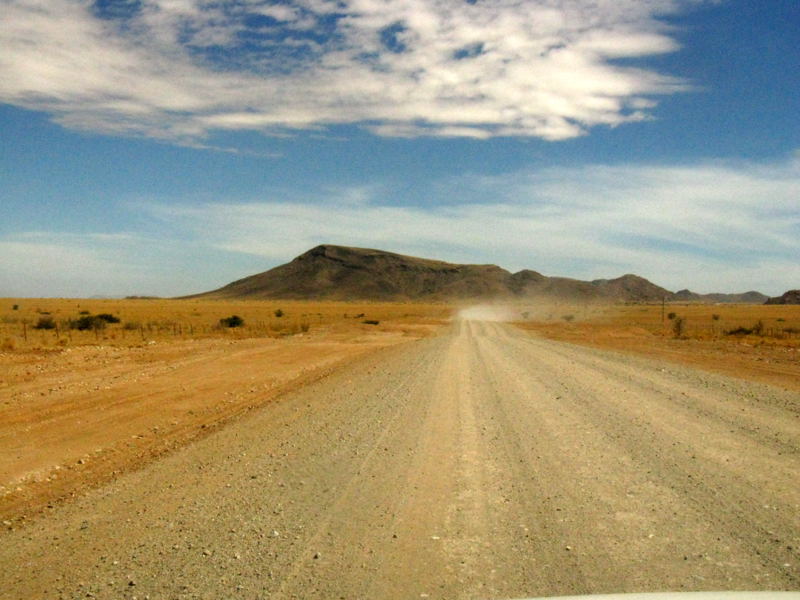
Back onto gravel roads, we were reminded again it doesn’t pay to follow the vehicle in front of you too closely.


Better to hang back a little or it’s guaranteed you will eat dust all day long.


By 11 AM, it was time for more cold drinks and a driver switch, so we made a quick stop at Solitaire for supplies.


Solitaire is little more than a smudge on the map but has a small lodge, small gas station, small bakery, small convenience store, and small restaurant all on a compact spot of land just off the road.

When I went into the store, I was surprised to see these ancient typewriters as part of the proprietor’s collection.


This old Underwood looks just like the one my sister bought sometime in her grade school years when she suddenly decided to learn to type. She could always do that—simply decide she wanted to accomplish a goal, gather the tools and knowledge to do it, and promptly accomplish it. She couldn’t afford anything much better than this old Underwood (our folks didn’t want us to ruin their good typewriter) and she bought a 33⅓ rpm record that was the audible Mavis Beacon Teaches Typing of its day. It took a lot of months of my listening to her record drone “A…S…D..F… Now, J…K..L…” before she learned to type. But once she did, she typed like the wind. Not having that kind of patience, I would try my hand at it, but become immediately frustrated when the old typewriter did this in response to my efforts.


Unlike my sister, who had a far larger frustration tolerance, I learned to type  much, much later.

The mountains played out as we continued on C14 but just before the point the road crossed the Kuiseb River, suddenly there were hills outside the truck windows and dips in the roadway leading to the river floor.


It was fascinating to see this ravine crop up out of what seemed to be nothing but flat land as far as the eye could see. We stopped to walk around a bit and marveled at the variety of rocks (and huge chunks of quartz!) on the sand at the river’s edge.


Weavers’ nests dangled from the trees like Christmas ornaments.

 Out of the Kuiseb River ravine, the road looked like it did before the river but the closer we got to Walvis Bay, the more desolate and moonscape-like it became.


The last thing you would ever expect at the end of such a protracted stretch of emptiness is this:


But there it was again, that amazing juxtaposition of empty desert ending right at the sea. Brilliant sunlight danced on the waves making it ideal for a carefree romp through shallow waters.


We pushed on to Swakopmund for groceries and then to our campground outside of Swakopmund for the night. The campsite was large and accommodating but best of all, had a nearby open field where at day’s end, you could watch the sun setting into the ocean a few kilometers beyond the ridge.

October 21, 2010

Casper of the Kalahari

In early October, we headed to the Kalahari for the weekend. The professor had heard about the Kalahari all his life, had always wanted to see it, and was anxious to finally see its expanse of red sand and the animals that live there.

We had reservations at the Gondwana Collection’s Kalahari Farmhouse which is an easy drive from Windhoek -- pretty much straight south to just shy of Mariental, then southeast toward Stampriet. We got there at mid-afternoon.


We were greeted at our car by a very friendly staff member who walked us from our car to the shady compound that housed reception. At reception, they had cold wet towels waiting for us to refresh our hands and faces after our hot drive and a tall glass of peach punch to counteract the day’s heat.


Path to Reception

Kalahari Farmhouse Reception

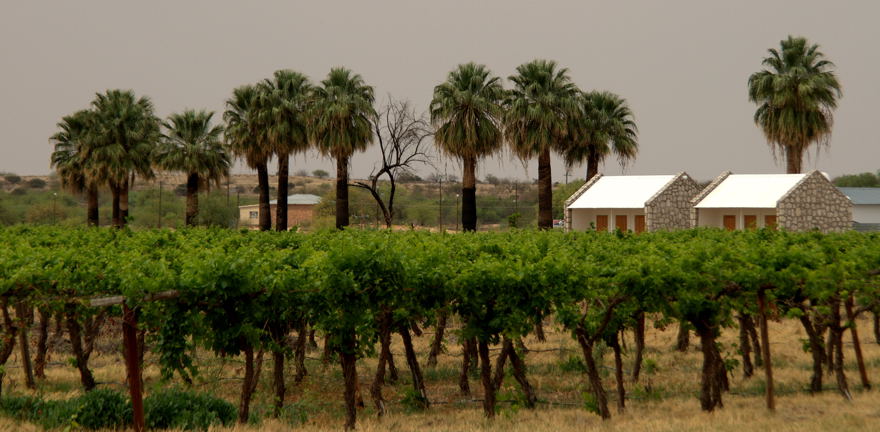
We moved our gear into one of the gorgeous little chalets styled after old Cape Dutch farmhouses.


We were too late to make that afternoon’s sundowner game drive, so we signed up for the next day’s drive and retreated to the poolside patio for a cold drink and some relaxing time planning a 4x4 camping trip with our kids for January.

 
We were absorbed in measuring distances on the map when we were interrupted by a tennis ball accurately bounced just to our feet by one of the animals of the Kalahari.

Casper of the Kalahari
Casper (whose humans pronounce it with British vowel sounds, ‘Cah-spur’) is the Farmhouse guard dog and has this routine down. Every day, new humans check into the Farmhouse and predictably fall captive to his irresistible smile and cheerful demeanor. The professor, who is a push over for all domesticated animals, happily surrendered to Casper’s wily ways. After 30 or 40 times either kicking or pitching the ball and stating firmly, “Okay, but this is the last time”,
 

we had to retreat to a walking tour of the grounds to stop Casper from wearing himself ragged chasing his ball. Besides, new people were arriving at the Farmhouse and he needed to get them indoctrinated by dinner time.

The Kalahari Farmhouse is a working farm with its own cattle, goats, and sheep which provide both meat and milk to produce the homemade cheeses they make on site;


chickens who provide both eggs and meat; and a large garden where they grow all the vegetables served at meals.


The property is ringed on one side by grape vines for sultana production.

 
Gondwana actively works at offering top notch training for their staff with language classes, hospitality industry, and skills training -- even sending some of them to Europe to learn cheese and bread-making with knowledgeable European artisan producers. It’s an amazing opportunity for many of these folks who can remain in their communities, have a great job with Gondwana, and learn skills they can capitalize on through their future. Too many rural Namibians don’t have those opportunities and must leave their rural communities to move to Windhoek or Swakopmund to try to find whatever employment they can to support their families.

 Dinner that night was a candlelit braai buffet on the patio. There were game steaks, lamb kabobs, bratwurst, lamb chops, numerous vegetable side dishes, and a gorgeous tiramisu for dessert.

 
By dinner time, Casper had met and indoctrinated all the new guests. People were cheerfully popping up from their chairs during dinner to take turns pitching the ball for Casper (the professor included, of course).

After dinner as we headed back to our chalet for the night, through the darkness we could still hear disembodied voices calling out in accented English, the same phrase over and over again –“Okay, but this is the last time”.