Showing posts with label Welwitschia. Show all posts

March 05, 2011

Camping Safari Day Nine – Twyfelfontein to Etosha West and a birthday party, too!


Our overnight destination for January 6th was the Gondwana Collection’s Etosha Safari Camp just south of the Anderson Gate entrance to Etosha. I had arranged with Safari Camp to have a birthday cake so we could celebrate the professor’s birthday that night. As a northern hemisphere dweller with a January birthday, the professor had been looking forward to this since we arrived last July --his first summer birthday ever! Even more special was that he got to celebrate it with all his family together in Africa! There couldn’t have been a better gift for him.

We left Aabadi Mountain Camp early, headed to Outjo and then to Safari Camp. Other than our trek through Etosha, this was going to be our last day traveling on gravel. Once we reached Khorixas, the remainder of our trip’s drive was going to be primarily on tar.

Coming out of Aabadi and headed to C-39, we were back in rolling hills and arid expanses of farms.
 
Small homestead with surprising satellite dish!

Our trusty vehicle on the road to Khorixas
Along this route, we did have the opportunity to see a Welwitschia mirabilis on the side of the road. These ancient plants with only two leaves have deep roots allowing them to survive in this hugely arid landscape – indeed thrive – they can get to be 2000 years old.


We made great time to Outjo, topped up the truck’s double diesel tanks just across the stations’ driveway from the illuminating paraffin (kerosene) pump,


and had a light lunch at the bakery just across the street.


 After a quick trip to the grocery store for supplies, we drove the last 90 kilometers on to Safari Camp for the night.

At Safari Camp we had a soft, grassy site with trees all around.

 
The trees’ occupants were varied and each of them, very busy.


Weaver building an engineering marvel

baby African Red-Eyed Bulbuls


After relaxing showers, we headed over to dinner and the birthday celebration for the professor.


Dinner at the Safari Camp’s outdoor courtyard is always enjoyable with great buffets and dinner entertainment by their guitarist/singers. When it was time for our dessert, the guitarists left the stage and headed inside.

Returning a few minutes later, they led a long line of folks out of the kitchen -- the chefs carrying the professor’s birthday cake followed by a full chorus of cooks, kitchen staff, managers, and wait staff. With apologies for the darkness of this video, what followed was this:


If you are going to have a birthday celebration, this is definitely the way to go! The folks at Safari Camp go way out of their way to make your visit memorable and the musicality and joyfulness of this group is amazing! Even as they headed back to the kitchen, it was a celebration of sound.


Thanks to the folks at Safari Camp and our indulgent adult kiddos’ willingness to come to Africa, the professor’s first ever summer birthday was perfect – he’ll never forget it. Nor will we.


The next day was going to be the kids’ first day at Etosha and what turned out to be an amazingly close view of a very impressive (but somewhat scary) pride of lions.


P.S. If you are having a down day, come back here and replay the birthday celebration video again. It’s guaranteed to cheer you up!

October 19, 2010

Swakopmund

We recently made a quick weekend trip to Swakopmund to see the sea. After months of endlessly sunny days, daytime temperatures now increasing into the 90’s, and dessicating single digit humidity in Windhoek, it was time to prove to ourselves that the ocean and humidity still exist. Well, they do, and only a mere 363 km (225 mi) from Windhoek. The trip traverses what has become familiar thorn and shrub veld until 20-30 km out from Swakopmund. The scenery then becomes much more desolate with thinly scattered plants on light colored sandy soil, occasional peeks of the Namib dunes to the south, and a hazy blue band of sea lying just on the western horizon.

About 20 km out from Swakopmund we began seeing clouds overhead. By the time we arrived in Swakopmund, it was completely overcast. Grey skies notwithstanding, the sight of the Atlantic ocean crashing onto the African continent was very welcome (and hydrating!).


The village of Swakopmund looks like a Bavarian movie set, built of stucco instead of wood -- but with palm trees!

 
Obviously, some seacoast inhabitants are present the world over.

Despite towering dunes of dry sand just at the edge of the sea, Swakopmund’s tropical climate provides for the growth of beautiful palm trees everywhere.


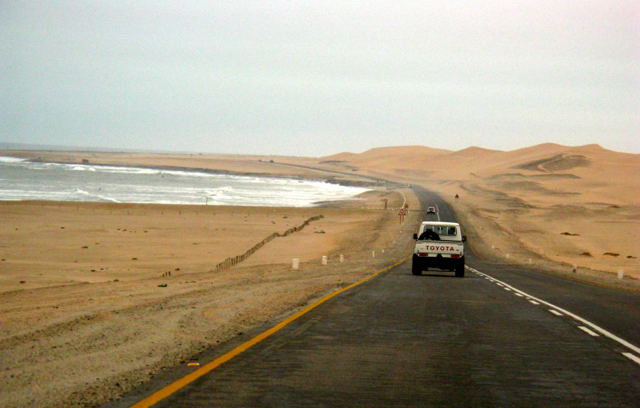
I was most anxious to see the phenomenon of sea on one side of the highway and towering dunes of the Namib Desert on the other. Hard as it is to believe, that’s exactly what it looks like.

Dunes on one side of the highway


Directly across on the other side of the highway
 
We decided to follow this incredible landscape down the highway to Walvis Bay, about 21 miles south of Swakopmund.

Road to Walvis Bay
Walvis Bay is Namibia’s only deep water port, home of its fishing industry, and also a migratory home to some flamingo and pelican colonies. Because this was just a quick one-hour jaunt, we only got to see a small flock of flamingos wading in the ocean just off the highway. It was still fun however to watch the water-walking take offs and landings and to take flamingo portraits.


 After breakfast the next morning, we drove out to the desert to see more of the dunes and the fascinating Welwitschia plants that are native to Namibia.

Traversing the desert was unlike any other drive we’ve made. It could just as well have been the moon. Across big swaths of desert terrain there was absolutely nothing but sand.


 There are some overlook areas of folded rocks

  but soon enough, it’s back to nothingness.

Just about the 100th time we remarked that we couldn’t believe how desolate it was, we saw a figure running to get away from our oncoming car.


Nothing could have been more unbelievable in the midst of nothingness!


A few kilometers further down the road, we found the Welwitschia.


It’s an amazing plant that can live up to 2000 years. Ostensibly for the entire 2000 years, there are never more than 2 leaves in this entire assembly. The leaves get tattered and wound around in a tangled mass, but the plant never grows additional leaves. A little further away was a young Welwitschia just getting started on its long life.


On leaving the desert, we had a quick lunch back in Swakopmund, said our good-byes to the sea,


and headed east back to Windhoek.

About an hour before arriving back in the city, we snapped a fuzzy photo of the African sunset as we whizzed by.

 
It’s no wonder folks here like their sundowners, taking the time to ponder the amazing sunsets.